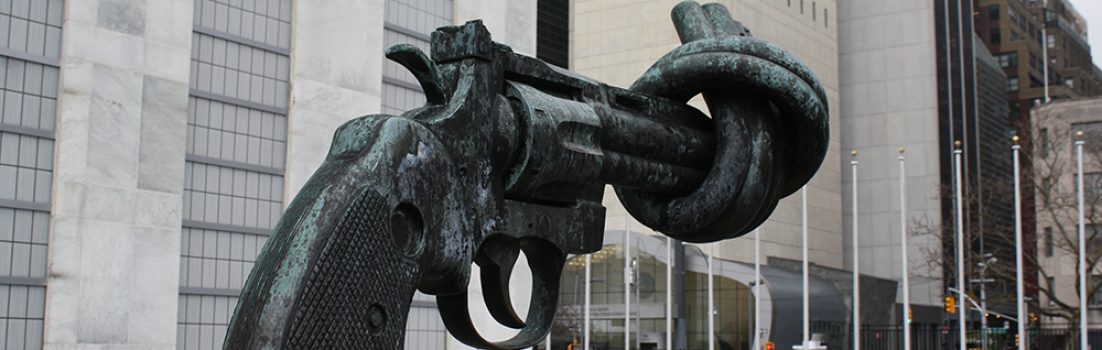

The following reflection is from Karen Leguizamón, a Pace University undergraduate who participated in the POL270 Global Politics of Disarmament and Arms Control class in Fall 2025. Students had the opportunity to engage in civic engagement assignments with disarmament advocacy efforts in the context of the UN General Assembly First Committee (Disarmament and International Security) meetings in New York City.
Before this class, international disarmament and arms control policy seemed far away. It was something that diplomats worked out in secret, and I only remembered their names for tests. I never thought I would actually meet them.
Ironically, violence was never completely abstract to me. I was born in Colombia, a country where gun violence has had a big impact on history, politics, and everyday life. But for a long time, that violence seemed both real and far away. It was in stories, news headlines, and the memories of many people, but it wasn’t always easy to see in my own life. Through my civic engagement experience, disarmament became real, human, and impossible to ignore.
I lived in Colombia until I was 15. This taught me that weapons weren’t just ideas. Armed conflict, such as that between criminal groups, guerrillas, and cartels, destroyed people’s homes, families, and how they saw the state. Violence often seemed normal or was pushed to the side as if it were just there and couldn’t be stopped. This class made me think about how societies learn to deal with violence and how conflict can be handled.
Visiting the United Nations this semester, we were able to observe meetings of the General Assembly First Committee (Disarmament and International Security). Being in that room, with delegates talking about weapons that could kill many people, changed the way I thought about global security. The talks showed that power, fear, and national interest often shape disarmament policy, even when it goes against humanitarian needs. It made me think about places like Colombia, where the effects of armed violence last a long time, even when the fighting is said to be over.
Going to the disarmament exhibit at the UN, I saw the human cost of policy choices around weapons. Survivor stories, history, and examples of landmines and cluster munitions demonstrated that weapons do not vanish by the signing of treaties – their effects last through generations.
I particularly appreciated the opportunity to watch Izumi Nakamitsu, UN High Representative for Disarmament Affairs, address the Committee. Seeing a woman in charge of one of the most important parts of international security made disarmament seem more real. Her work showed that progress in this field is slow and limited by politics, but it is still very important. It made me think that we can push for accountability, even when governments don’t want to change.
This civic engagement experience enabled me to see myself personally in international politics. Visiting the UN turned distant concepts to actual possibilities – I can imagine pursuing a future in international law or humanitarian disarmament, finding places where education, memory, and action meet. As a political science student, watching diplomacy in action made me realize that my lived experience, as someone from a country affected by violence, is important to talks about disarmament. Maybe I will be able to help my own country pursue a more peaceful future.